Films, books graphic novels, podcasts, screenings, talks, commentary, thrills, scares, entertainment: all the shades and feelings of Noir, starting November 30th
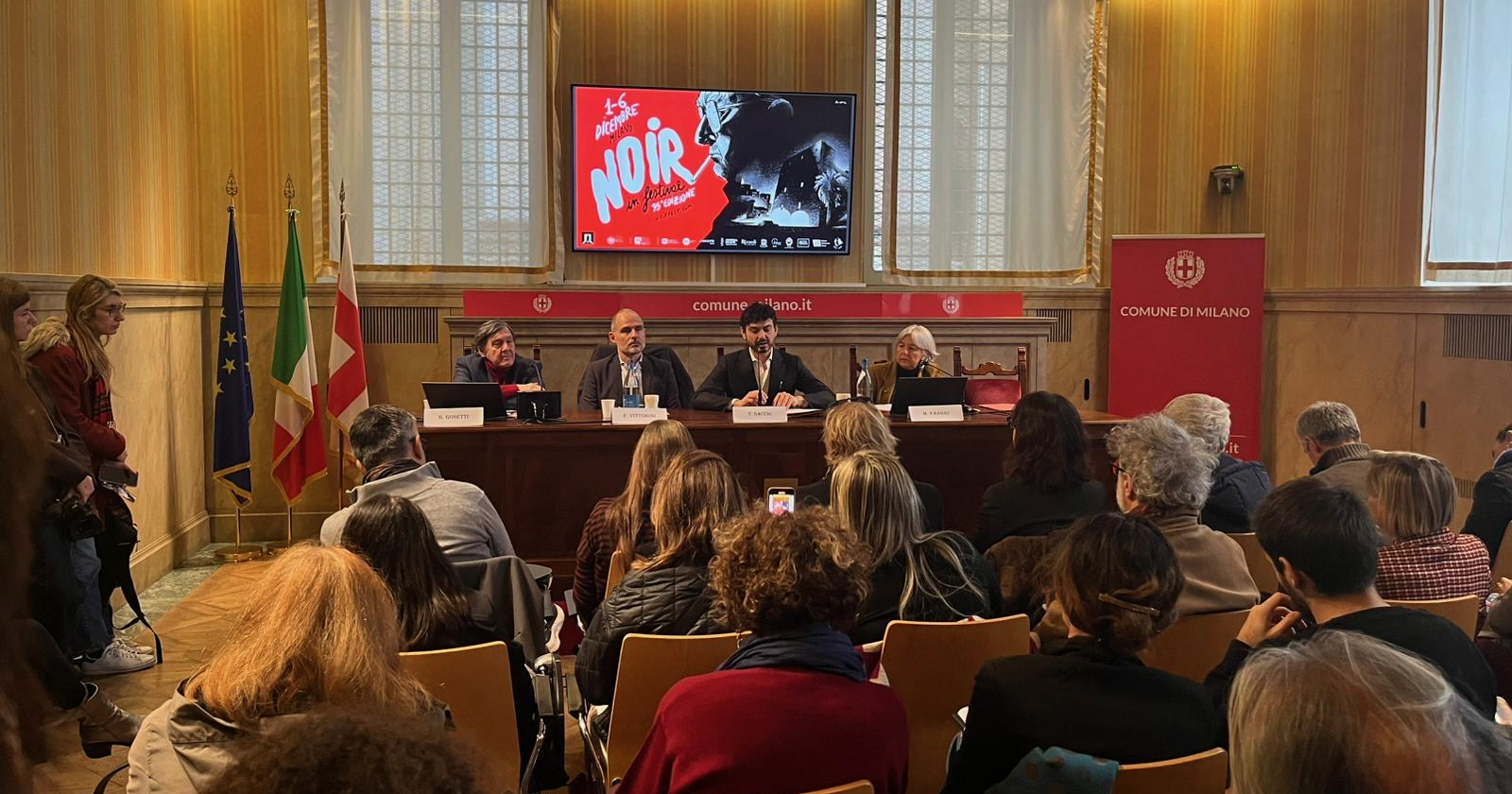
An eagerly awaited pre-opening event on Sunday, November 30th, together with Maurizio de Giovanni, ushers in the 35th edition of Noir in Festival, directed by Giorgio Gosetti and Marina Fabbri, who share and swap roles as they cover all the bases of film and literature, comics and podcasts, reports and new media in the ever-changing landscape of the year’s most celebrated noir event. From the campus of IULM University (partner and “heart” of the event), to the cinema Arlecchino – Cineteca Milano, the Casa del Manzoni (prize venue of the Giorgio Scerbanenco Award), and the Rizzoli Galleria Bookshop (where great books rule), from the 1st to the 6th of December, Milan welcomes back its secret soul and a special tribute to Andrea Camilleri, immortalized in our poster designed by the illustrator La Came in her signature style, on the centenary of the great author’s birth.
The opening cinematic event of Noir in Festival 2025 on December 1st is the world premiere of the Sky Original series Amadeus, based on the play by Oscar-winner Peter Schaffer, starring Will Sharpe (Mozart) and Paul Bettany (Salieri), and directed by Julian Farino and Alice Seabright. On the same day and until Saturday, December 6th, the official selection unfolds, consisting of 7 films in competition, 1 out of competition, 4 special events which include a homage to contemporary Italian noir fiction (the RAI doc Chi è senza colpa by Katiuscia Magliarisi, directed by Riccardo Alessandri), the return of an auteur classic, Angel’s Egg, the masterful ‘anime’ by Mamoru Oshii), and the Venice title that caused such a stir, No Other Choice by Park Chan-wook.
The films in competition (all Italian or international premieres) speak many different languages but all of them star a multi-ethnic Europe, simmering, angry, reaching out its tradition to far-off lands like Cameroon in Untamable, by the formidable humorist and actor Thomas N’Gijol, or the exotic Maldives in Hell in Paradise by activist Leila Sy.
The other titles flying the French flag form a genuine example of a society that has become profoundly multi-cultural, a world where Georgia’s Akaki Popkhadze sets the wars of the Russian mafia in sunny Nice (In the Name of Blood); second-generation Parisian Peter Dourountzsis describes all the ambiguity of crime reporters hunting for scoops (Vultures), while the only native-born French director, Mélissa Drigeard, treats us to an all-female gangster story going down in the environs of Avignon in the 1990s (Unsubmissives).
Not so far away, Catalonia steps up, offering the secret world of a hired hitwoman with mysterious affinities to a sea creature in A Whale, an atmospheric neo-noir by Pablo Hernando. Lastly, an Italy you would never expect emerges in Beasts of Prey, the feature directorial debut of Andrea Corsini, starring the body horror diva Carolyn Bracken, and the first production by EDI Effetti Digitali Italiani, a surprising woman’s tale with an international appeal.
Diversity is also the byword of the literary talent on display at the talks in the Rizzoli Galleria this year, starting with a Noir in Festival habitué like Maurizio de Giovanni, with his latest and quite original novel L’orologiaio di Brest (Feltrinelli), about power and the ties between ideals and cynicism and the individual and history, a fresh take on the age of Italian political mysteries and crooked secret services. Next up, the big questions about geopolitics and its spies, new powers and enigmas, with Giuliano da Empoli, author of the popular Il mago del Cremlino (Mondadori), brought to the screen by Olivier Assayas and presented in Venice, and Da Empoli’s new novel L’ora dei predatori (Einaudi), introduced by Antonio Monda.
There’s loads of Italy, as well, in the Noir talk series: from Marco Vichi’s Florence and his beloved Inspector Bordelli in the ‘70s in Notti nere (Guanda); Gian Andrea Cerone’s parallel investigations in Milan and the Val di Fassa in his new book La curva dell’oblio (Guanda); or Naples as seen by the rapper and author Daniele Sanzone, who in Bumerang (La nave di Teseo) reveals the all-too-human inferno of the Scampia quarter, together with Gianni Biondillo, who knows a thing or two about mainly Milan’s rough edges; while sports reporter Marco Bellinazzo takes us to soccer-happy Naples, where dreams can end up as nightmares, in his new novel La colpa è di chi muore (Fandango Libri).
We wrap up our literary lineup with two special tributes and pet projects of ours: one being the “marriage” between French and Italian noir novels in the title Il confine della vergogna (Edizioni Le Assassine), by Michèle Pedinielli and Valerio Varesi, the brainchild of Lyon’s Festival Quais du Polar and the edizioni Points as part of a campaign to showcase Lyon and Milan, UNESCO Creative Cities of Literature. The other is a fond homage to filmmaker Claudio Caligari, for whom our Italian film prize is named, and the object of a tribute by Elisabetta Sgarbi’s magazine Pantagruel on the tenth anniversary of his death, and which Noir presents with the screenwriters of Don’t Be Bad, Francesca Serafini and Giordano Meacci and producer Simone Isola.
At the core of the literary pantheon that Noir in Festival reserves for noir fiction offerings, there are always its two highest awards, touchstones of the popularity of the genre: the Raymond Chandler Award for Lifetime Achievement and the Giorgio Scerbanenco Award for best Italian noir novel of the year. So it isn’t surprising that this time, the Chandler Award goes to an immensely popular author – with no small help from the TV series from Slow Horses and Down Cemetery Road – like Mick Herron, published in Italy by Feltrinelli and world-renowned on Apple TV+.
No surprise, either, that the five finalists for the Scerbanenco Award tapped by the jury are representatives of territories and styles as different as Davide Longo, Alessandro Robecchi, Barbara Baraldi, Giorgia Lepore, and the Irish Italian Mirko Zilahy. Nor that the winner of the Lignano Sabbiadoro Readers’ Award is Salerno’s own Antonio Lanzetta, whose hypnotic L’educatore (Newton Compton) tells the tragedy of childhood abused, in a style that critics liken to that of Stephen King.
As it does every year, Noir elects IULM University as the venue for its series of talks and conferences about the changing noir genre and its new tools. Audiences can catch conversations with the original creators of comic books and graphic novels. It starts on Monday, December 1st, with Jacopo Starace and his story Smiling Woods e i diavoli, made for Bao Publishing and summoning up shades of Stephen King and David Lynch to impart secrets and disappearances in a quiet American town. Next, Laura Camelli aka La Came muses on what comics mean to her, from her cinematic Malanotte – La maledizione della Pantafa, published by Coconino Press, to her large and fertile footprint in the collective Mammaiuto.
Lastly, anticipation runs high for the talk with Spugna and his Cattivik 2.0. To celebrate the 60th birthday of the most awkward, adorable evil genius in comics, Gigaciao has entrusted Cattivik to the rising generation of his fans, this time with a whole new challenge: an outright “novel’ grafik”: a lengthy, fast-paced criminal adventure written by Lorenzo La Neve and drawn by Spugna under the supervision of the maestro Silver.
Another series of events is devoted to the protagonists of several podcasts with a strong narrative appeal. Ever since Noir started, in fact, it has always scouted out narrative forms that wield the genre to tell human, personal or collective, private or public stories, in order to contemplate the past, understand the present, and wonder what the future will bring. In this year’s edition, first Andrea Maltagliati and Guido Guerci (respectively producer and co-writer of Il banchiere di Dio di Nicolò Majnoni), then Sara Poma (Figlie, La città dell’amianto) will duly share their experiences with IULM audiences, in a dialogue about the production of genre narratives and the choice of stories to be conveyed.
And the masterclass with British film expert Adrian Wootton is back this year, on the historic relations between the noir genre and musicals. Noir previews examples and models of the synergy in its lineup held during the Uno, due, tre… festival!, over the week between November 24th to 30th, at the Cinema Arlecchino – Cineteca Milano.
“It is always a uniquely fascinating adventure,” declare Marina Fabbri and Giorgio Gosetti, “amidst the wealth of ever-growing cultural events and genre events that prosper in our country, to strike out across the parallel yet kindred territories of cinema and literature, comics and journalism, explored by Noir in Festival for 35 years now, with unflagging passion. This year as never before, we are proud to place our bets on a program that makes choices, prefers quality to quantity, and offers an original, thought-provoking perspective on the genre that epitomizes the world we live in. Shadows, intrigues, crimes and misdeeds, heroes and villains populate our world and our imagination; the gazes of eminent seasoned artists and passionate young newcomers take some of the fear out of those shadows. Thanks to the institutions and partners who believe in us and have stood by us this year as well, and thanks to the sheer drive of our collaborators (a splendid, irreplaceable team), we nurture the stubborn ambition to cast light on the darkness of today’s world.”
While Noir in Festival 2025 kicks off with the voice of a beloved author like Maurizio de Giovanni, who probes that most undecipherable bond between fathers and children, this edition adds a new jewel to its crown: the premiere of a heart-pumping thriller, Primate, the spectacular new “natural horror” by Johannes Roberts. Primate will be one of the most original hit horror films of the coming year, a title that combines dark humor and pure animal terror, and even if you love movies that test your nerves to the breaking point, maybe you should think twice before petting a chimpanzee.
We think we’ve provided a guide that sums up the multiplicity of our festival and shows all the facets of a more and more diversified imagination, one that might even chart new borders between conscious and unconscious. We wish you shivers of delight!

